+86-13735376777 tosenauto@gmail.com


Replacing a manual transmission represents a major capital investment. This project often triggers a difficult financial and mechanical debate for vehicle owners. You must decide if repairing an old unit makes sense. Sometimes, upgrading to a completely new system is the better choice. Whether dealing with catastrophic internal failure on a daily driver or upgrading to handle a high-horsepower engine build, selecting the right unit requires moving beyond basic gear counts. Basic gear numbers simply do not tell the whole story. A successful transmission replacement relies on accurate diagnosis first. You must align torque capacity with engine output carefully. You also need to verify physical fitment and account for overlapping installation costs. This guide will walk you through these crucial steps. You will learn how to avoid common pitfalls during installation. We will also help you choose the best replacement hardware for your specific driving needs.
Verify before replacing: Many "transmission failures" are actually misdiagnosed clutch or hydraulic linkage issues.
Torque over gears: Peak engine torque—not horsepower—dictates the minimum rating for a viable replacement transmission.
Fitment dictates cost: Upgrading to a modern, robust manual gearbox often requires custom installation kits to avoid extensive floorpan modifications.
Overlap repairs save money: Replacing the rear main seal and slave cylinder during a transmission swap prevents expensive secondary labor charges later.
Start by evaluating the exact symptoms your vehicle exhibits. We need to clearly differentiate between minor internal issues and catastrophic failure. Hard shifting often points directly to worn synchronizers. A vehicle popping out of gear usually indicates linkage issues or bent shift forks. Mechanics can usually resolve these problems through minor repairs. Conversely, a cracked outer casing means you need a full replacement. Catastrophic gear tooth failure also mandates a completely new unit. Ignoring these severe symptoms will only lead to roadside breakdowns.
Symptom | Probable Cause | Recommended Action |
|---|---|---|
Spongy pedal, hard shifting | Hydraulic slave cylinder or air in lines | Minor Repair / Bleed system |
Popping out of gear | Worn synchronizers or bent shift forks | Rebuild / Replace affected gears |
Loud grinding, metal chunks in fluid | Catastrophic gear tooth failure | Full Replacement |
Visible fluid leaking from cracked case | Structural casing failure | Full Replacement |
Many vehicle owners fall victim to the "Total Loss" myth. They assume a high repair bill means they should immediately buy a new car. Let us look at the financial reality. Spending $2,500 to $3,500 on a replacement gives you years of reliable operation. This investment is vastly more economical than absorbing the massive cost of buying a new vehicle. It also saves you from taking a financial risk on an unknown-condition used car. Keeping your current chassis on the road usually makes the most mathematical sense.
The economics of rebuilding versus replacing remain straightforward. Standard clutch and synchronizer repairs generally take 4 to 8 labor hours. They cost much less than a full swap. However, severe internal damage changes the math completely. High-mileage wear makes sourcing a complete replacement transmission the more viable choice. A remanufactured unit provides a warranty-backed solution. You gain immediate peace of mind and long-term reliability. Opting for a fresh unit prevents you from paying continuous diagnostic fees down the road.
Torque capacity acts as the ultimate king when selecting new hardware. Peak engine torque dictates your minimum safety rating. Horsepower remains secondary in this specific context. A high torque manual gearbox is non-negotiable for modified engines. Heavy towing applications also require exceptionally robust torque ratings. Older legacy 5-speeds often max out around 265 lb-ft of torque. Pushing them past this limit guarantees internal failure. Modern heavy-duty options can handle 600 to 700+ lb-ft easily.
Physical fitment presents another harsh implementation reality. Bigger is not always better in the automotive world. A massive, heavy-duty unit might require heavily cutting your transmission tunnel. This structural modification weakens the chassis and ruins interior carpets. Compact casing designs are crucial for aftermarket swaps. They preserve your vehicle floorpan and save thousands in custom fabrication labor. Always measure your transmission tunnel clearance before ordering a large aftermarket unit.
You must also evaluate your overdrive and gearing needs practically. A 5-speed setup features a single overdrive gear. It weighs less and handles sub-600 lb-ft street applications well. A 6-speed setup offers a double overdrive configuration. It suits high-speed highway cruising perfectly. Six gears also help you hit aggressive fuel economy targets on long road trips. Choosing the right gear count depends entirely on your daily driving route.
Gearing & Application Profile Chart | |||
Gearbox Type | Overdrive Count | Best Application | Weight & Fitment Profile |
|---|---|---|---|
Classic 4-Speed | None (1:1 Final) | Vintage restorations, drag racing | Very compact, lightweight |
Standard 5-Speed | Single Overdrive | Street cruisers, daily commuting | Moderate size, easy tunnel fitment |
Modern 6-Speed | Double Overdrive | Highway cruising, pro-touring | Large casing, may require modifications |
High-RPM shift capability matters heavily for performance applications. Older gearboxes often bind or lock up above 6,200 RPM. This lockup happens because legacy synchronizers cannot match gear speeds fast enough. Purpose-built modern replacements are engineered entirely differently. They feature advanced carbon-lined synchronizers. These upgrades deliver seamless, butter-smooth shifts at 7,500+ RPM. If you plan to track your car, you need this high-RPM capability.
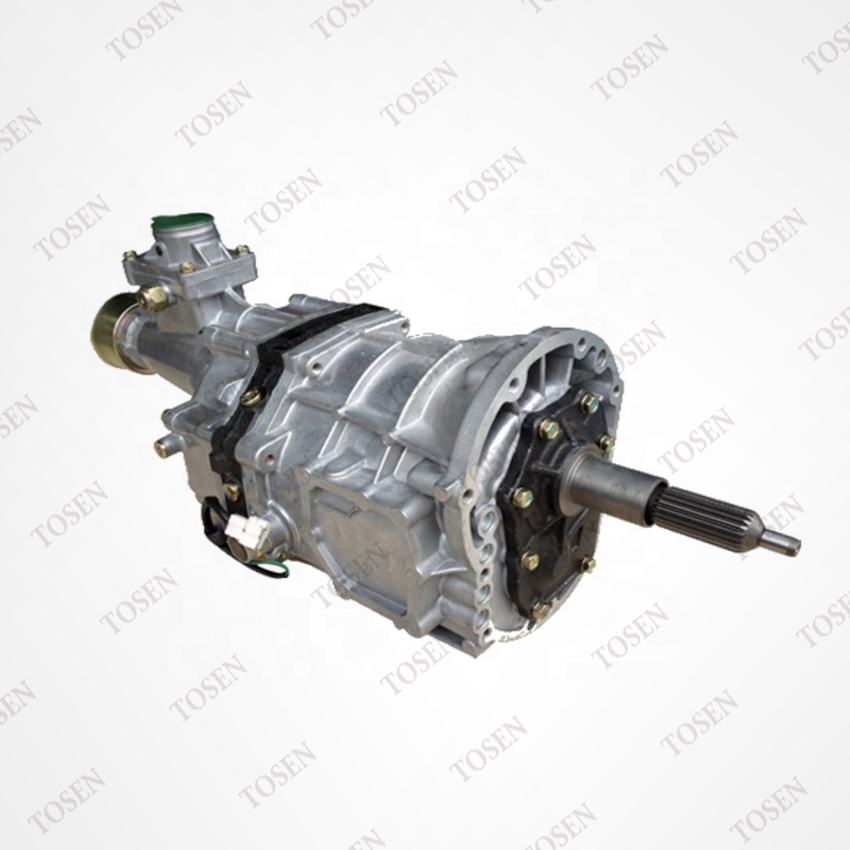
Direct-fit OEM replacements solve specific problems perfectly. Replacing a broken unit with an exact factory match is optimal for standard commuter cars. Standard light trucks also benefit immensely from this direct-swap approach. For example, installing a standard Toyota Hilux gearbox makes perfect sense for commercial work vehicles. Retaining factory payload capacity is absolutely vital. Proven OEM reliability outweighs any desire for aftermarket performance customization in commercial fleets.
Aftermarket performance transmissions serve a completely different purpose. Popular aftermarket architectures, like modern TKX or Magnum equivalents, target specific high-stress use-cases. They solve the inherent fragility of older legacy transmissions. They easily handle modern LS or Coyote engine swaps without breaking a sweat.
Direct-Fit OEM Benefits: Zero floorpan modifications, guaranteed factory driveshaft fitment, predictable clutch pedal feel.
Aftermarket Upgrade Benefits: Massive torque capacity increases, high-RPM shifting abilities, customizable gear ratio selections.
Shifter alignment presents a critical implementation risk during any custom swap. You must ensure the new shift lever lines up perfectly with your factory center console. Misalignment ruins the interior aesthetic and makes driving uncomfortable. Offset side shifters provide an excellent solution here. They allow you to route the shift lever perfectly into the factory location. This clever engineering prevents unwanted interior modifications and preserves your car's resale value.
Replacing a manual gearbox in complete isolation is a rookie mistake. You must address ancillary components while the bellhousing is removed. Mandatory inspection and replacement of adjacent parts saves money long-term. Skipping these steps guarantees you will drop the unit again within a few months.
Inspect and Replace the Rear Main Seal: This engine seal sits directly behind the flywheel. Replacing it now takes ten minutes. Replacing it later requires removing the entire driveline again.
Install a New Pilot Bearing: This small bearing supports the input shaft. A worn pilot bearing causes severe shifting issues and destroys input shaft tips.
Upgrade the Hydraulic Slave Cylinder: Hydraulic seals degrade over time. Install a fresh slave cylinder while you have open access to the bellhousing interior.
You face specific flywheel realities during this heavy repair job. Sometimes, a mechanic can simply resurface your existing solid flywheel. This approach saves money on standard setups. However, certain modern designs demand complete replacement. Strict replacement rules apply to dual-mass flywheels. You cannot safely resurface a dual-mass unit on a brake lathe. Reusing a worn dual-mass flywheel guarantees severe driveline vibrations and premature clutch failure.
Proper shop tooling and rigorous setup organization prevent costly installation errors. DIY installers need the right equipment before unbolting anything. You need dedicated transmission jacks to lower heavy units safely. High-quality impact tools make removing stubborn bellhousing bolts much easier. Rigorous organization of fasteners keeps the project moving smoothly. We recommend using labeled magnetic trays to separate engine bolts from crossmember hardware.
You must look beyond the basic box when making your purchase. The internal hardware is only 50% of the overall equation. The quality of your surrounding installation kit makes or breaks the project. You need sturdy fabricated crossmembers to support the new weight. Precise driveshaft yokes ensure vibration-free power delivery. High-quality hydraulic clutch adapters are also mandatory for a smooth pedal feel.
Post-sale technical support provides incredibly valuable safety nets. Evaluate vendors based on their ability to troubleshoot complex setup issues over the phone. You might need expert help dialing in hydraulic clutch release angles. Diagnosing mysterious driveline vibrations also requires expert assistance. A vendor who ignores your calls after the sale will leave you stranded in your garage.
Examine warranty terms and remanufacturing standards carefully. Buyers must scrutinize testing protocols before buying a manual transmission. Reliable vendors dyno-test their remanufactured units prior to shipping. This rigorous testing ensures out-of-the-box reliability. The dyno process verifies gear engagement and checks for fluid leaks under load. You want a product guaranteed to perform immediately after installation, not a secondary repair project.
Choosing the right replacement unit requires balancing multiple mechanical and financial factors. You must balance the vehicle’s raw power output against physical chassis constraints. Your intended use-case also heavily drives the final decision. Towing, daily commuting, and weekend racing all demand completely different gearing and torque strategies. Rushing this decision often leads to expensive rework and ruined interior consoles.
As your next step, you should consult with a specialized shop or a dedicated aftermarket vendor. Map out a complete, itemized parts list before ordering your core unit. Ensure your comprehensive list includes all necessary adapters, custom crossmembers, and overlapping seals. Proper upfront planning guarantees a successful, durable, and highly enjoyable installation.
A: A standard replacement typically costs between $1,500 and $3,500, depending heavily on the vehicle model. Labor usually accounts for $500 to $1,000 of this total, while the hardware makes up the rest. This repair is generally much cheaper than fixing a complex automatic transmission, which often exceeds $4,500.
A: Yes, it happens frequently. A worn pressure plate or a failing hydraulic slave cylinder prevents the clutch from disengaging fully. This causes severe hard shifting and loud gear grinding. Mechanics often misdiagnose this simple linkage or hydraulic failure as catastrophic internal gear damage.
A: It depends on the extent of the internal damage. Rebuilding is highly cost-effective for minor synchronizer or bearing wear. However, you should replace the entire unit if you suffer catastrophic gear tooth failure, find a cracked casing, or plan to significantly upgrade your engine power.
A: A high-quality replacement can easily last 100,000 to 150,000 miles if treated properly. Longevity ties directly to your strict maintenance intervals and daily driving habits. Following the standard 30,000-mile fluid change rule prevents premature bearing wear and keeps gear shifts smooth.
